The largest study of children’s physical activity in Denmark
Moving Denmark is the largest study of physical activity ever conducted in Denmark. In 2025, nearly 198,000 Danes aged 3 years and older participated, including approximately 55,000 children aged 3–14 years. This makes it the largest and most detailed study of children’s movement behaviors, play, and sport participation in Denmark to date.
Mette Toftager from the World Playground Research Institute team contributes as a researcher on the project.
Studying children’s play and physical activity on such a large scale is important because movement behaviors are shaped by many different factors, including age, gender, and access to opportunities for play and sport. The large sample size allows us to identify patterns and differences across population groups and municipalities that would not be visible in smaller studies.
This knowledge helps researchers, municipalities, schools, and organizations develop policies and initiatives that support active lifestyles and create environments that promote play, movement, well-being, and healthy development for all children.
How children play and move across age groups
The new report ‘Børns bevægelse i idræt og leg 2025’ (English: ‘Children’s physical activity in sport and play 2025’) reveals that active play is a central part of children’s lives. However, it also shows that both play habits and overall physical activity levels decline as children grow older.
Across all age groups, the most popular forms of active play are:
- Ball games (60%)
- Playground play (60%)
- Play on wheels such as cycling, scooters, or roller skates (58%)
Younger children are the most active players. Playground play, movement games such as tag and hide-and-seek, and imaginative play are especially common among 3–5 and 6–8-year-olds but become less frequent with age. Ball games, however, remain popular throughout childhood and are most common among 9–11-year-olds.
The same pattern can be seen in children’s overall physical activity levels:
- 47% of children achieve at least seven hours of physical activity per week, corresponding to the World Health Organization’s recommendation of an average of 60 minutes of daily moderate-to-vigorous physical activity
- Among 3–5-year-olds, 59% are active for seven or more hours per week, including 26% who accumulate 14 hours or more
- Among 12–14-year-olds, only 9% reach 14 hours or more of weekly physical activity
Figure 1: Weekly time with at least 60 minutes of physical activity, by gender. Percentage. Moving Denmark.
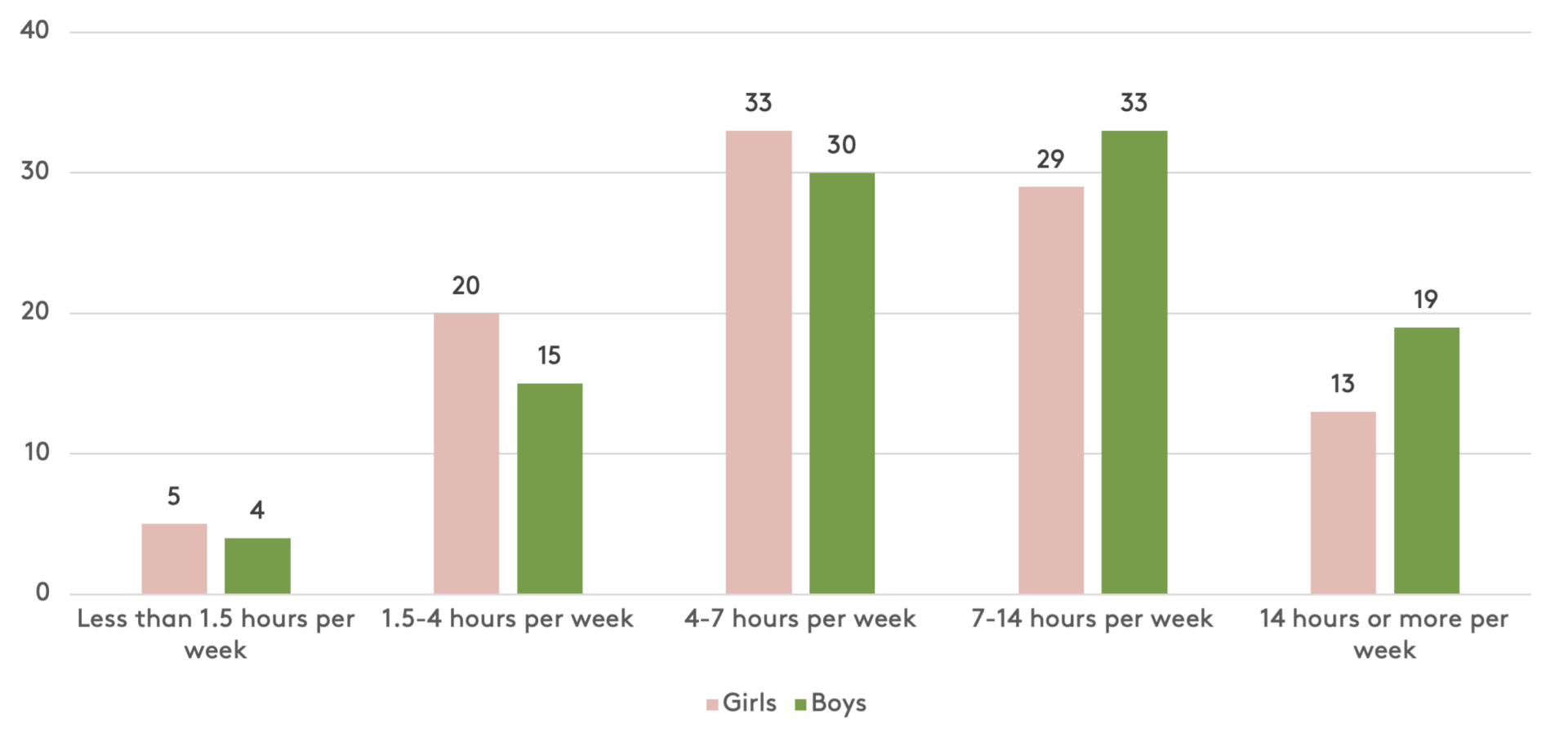
Figure 2: Weekly time with at least 60 minutes of physical activity, by age. Percentage. Moving Denmark.
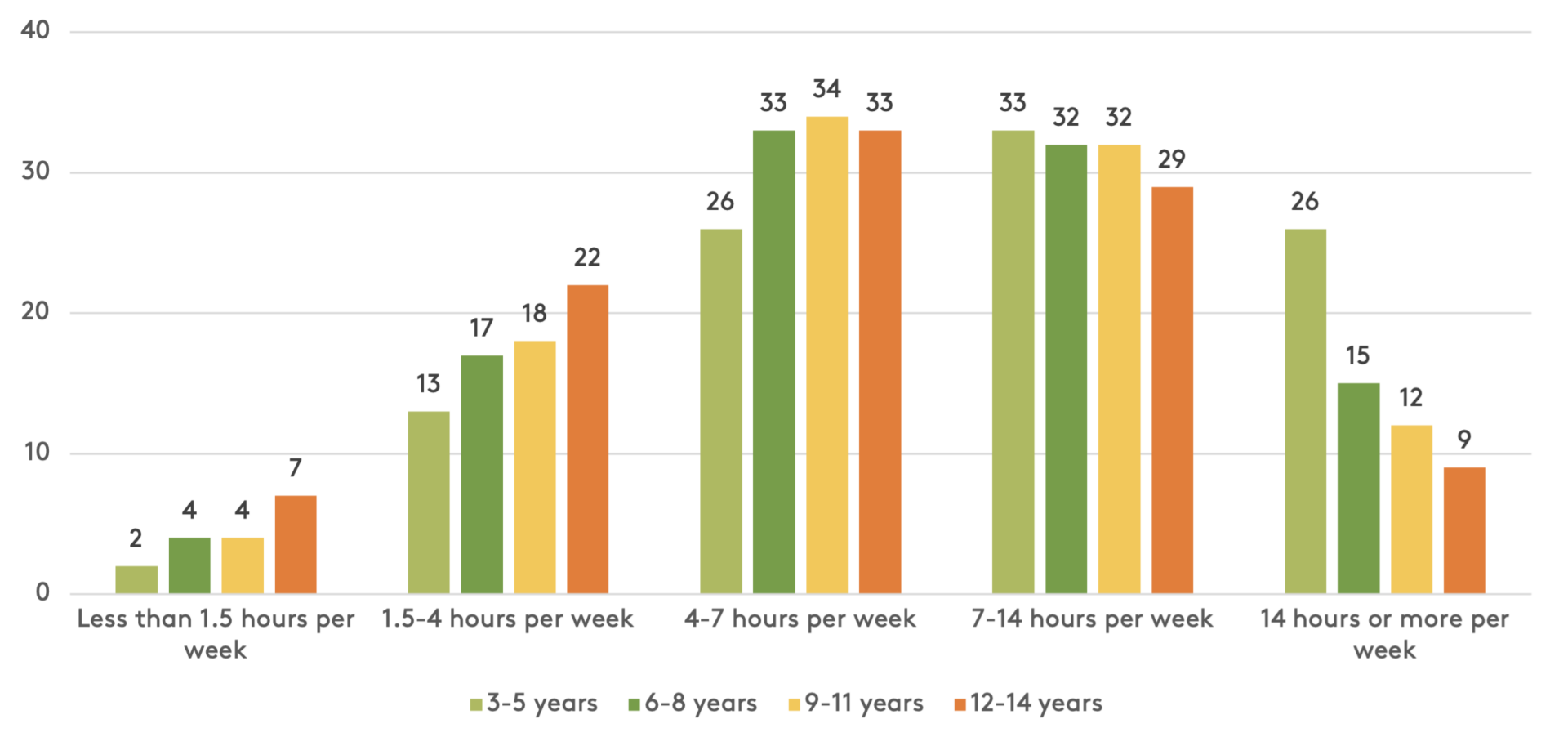
Overall, the findings suggest that active play is a key driver in younger children’s physical activity, while older children spend less time in play-based activities and accumulate fewer hours of physical activity overall.
These findings underline the importance of supporting opportunities for play and movement throughout childhood and adolescence, helping children stay active as they grow older.
How do children use playgrounds and local environments for play and movement?
The report highlights the important role that playgrounds and local environments play in children’s play and physical activity, particularly among younger children.
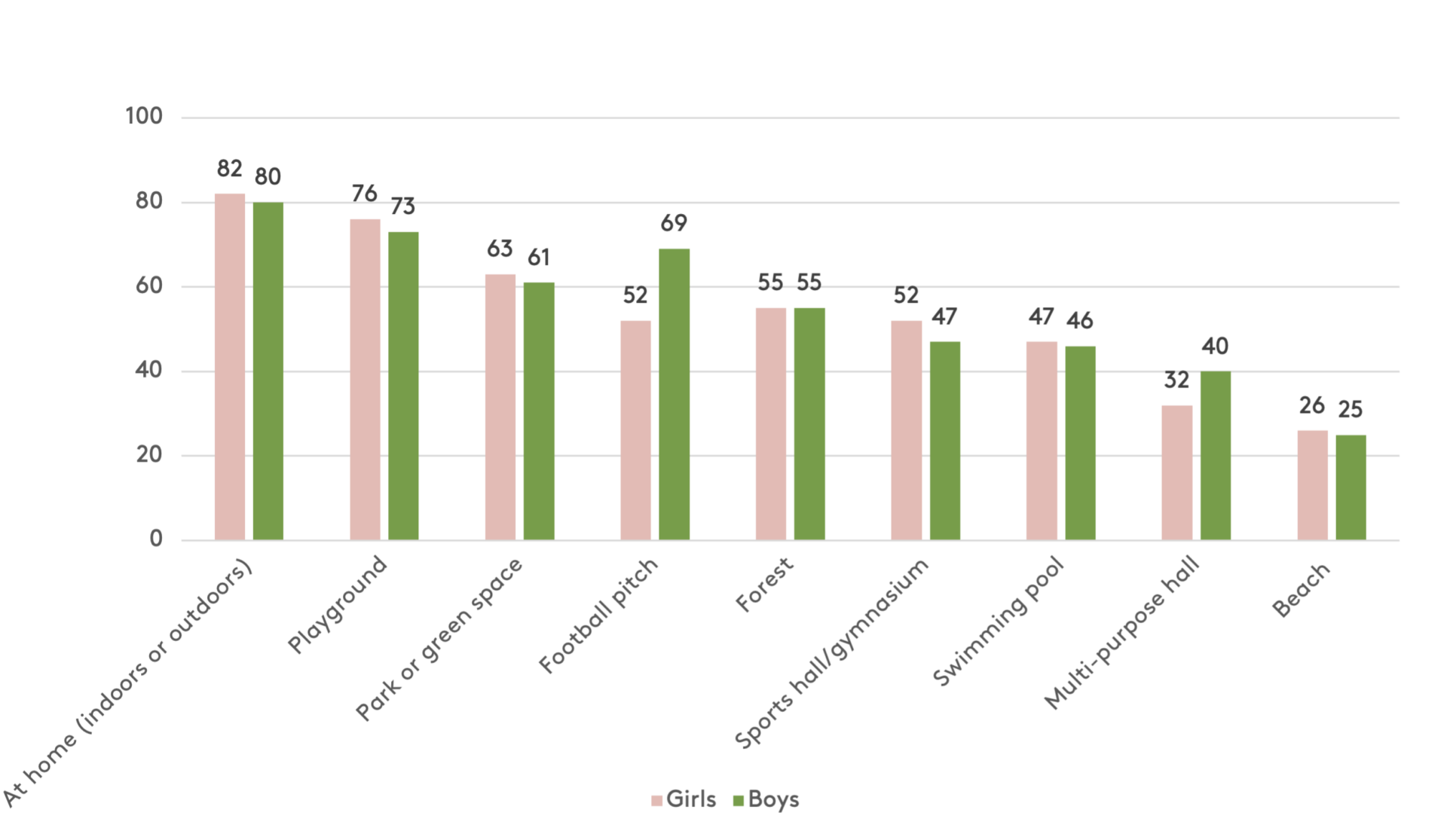
Overall, children most commonly perceive the following environments as good opportunities for movement:
- Home environment (81%)
- Local playgrounds (74%)
- Parks and green spaces (62%)
- Football pitches (60%)
- Forests (55%)
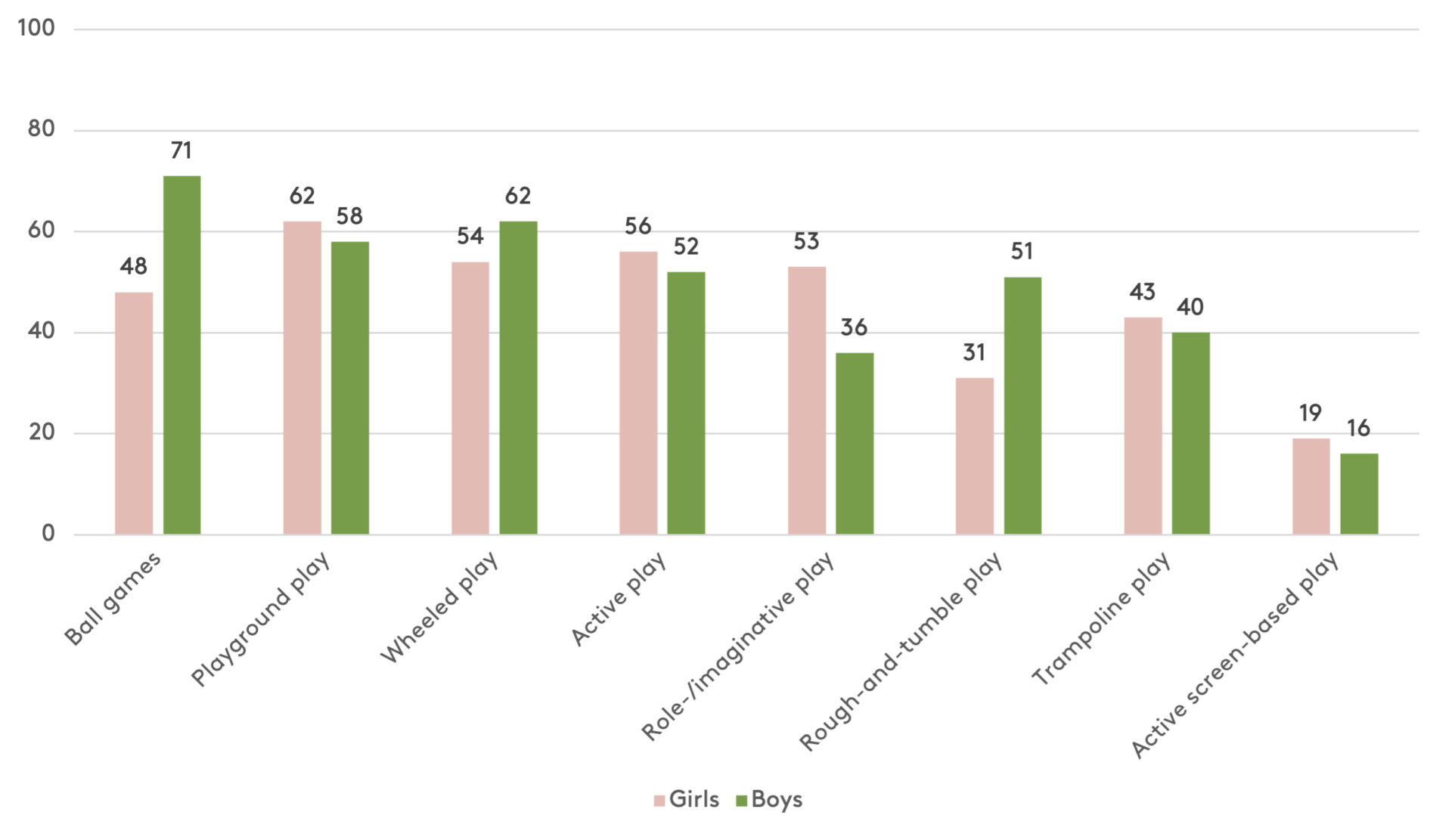
Figure 3: Proportion participating in active play at least once per week, by gender. Percentage. Moving Denmark.
However, the importance of these environments changes with age.
For younger children, playgrounds are a key setting for active play. Nearly nine in ten children aged 3–5 years report having good opportunities for movement on local playgrounds, and playground play is among the most common forms of active play in both the 3–5 and 6–8-year age groups.
As children grow older, playground use declines substantially. At the same time, imaginative play, movement games, and other forms of informal active play become less common.
Despite this decline, playgrounds remain an important destination for many children. Among 6–11-year-olds with access to a local playground, 44% visit a playground at least weekly for physical activity. This varies by age, with 48% of 6–8-year-olds visiting a playground at least weekly, compared with 39% of 9–11-year-olds.
The findings suggest that when children get older, their activity patterns gradually shift towards more sports-oriented environment. While playgrounds and the home environment are especially important for younger children, older children increasingly identify football pitches, sports halls, and multi-use games areas as key places for physical activity.
Parks, forests, and other natural environments remain important movement spaces across all age groups.
How boys and girls differ in play and activity
Overall, boys are slightly more physically active than girls:
- 52% of boys report at least seven hours of physical activity per week, compared with 42% of girls
- 19% of boys report 14 hours or more of physical activity per week, compared with 13% of girls
The report also reveals clear gender differences in the types of play children engage in:
- Boys are more likely to participate in ball games (71%), play on wheels such as cycling or scooters (62%), and rough-and-tumble or fighting games (51%)
- Girls, on the other hand, are more likely to engage in playground play (62%), movement games such as tag and hide-and-seek (56%), and role or imaginative play (53%)
Figure 4: Proportion who have good opportunities for physical activity in their local area, by gender. Percentage. Moving Denmark.
Traditional play environments still dominate
One positive finding that stands out is that many children (and their parents) report having access to key movement-friendly environments in their neighborhood, especially playgrounds. Around three out of four children indicate that they have good opportunities to use a playground near where they live.
At the same time, the report reveals that active play involving screens is very rare across all age groups. While digital media is a major part of children’s everyday lives, active play with a screen (for example augmented-reality games like Pokémon Go) is the lowest-ranked play type in all age groups, suggesting that screens are generally not used as a setting for physical, movement-based play.
This challenges the assumption that digital platforms are becoming an important arena for children’s physical activity or that they are replacing more traditional forms of play. Instead, the findings suggest that children’s active play is still primarily rooted in more traditional environments such as playgrounds, homes, streets, and sports settings.