Introduction
Research has shown that the design and layout of a playground impact children’s physical activity and play.
Decisions about layout, features, and equipment are often made by professionals such as landscape architects, playground designers, local authorities, and housing developers.
However, these choices can have a significant impact on how children play and how active they are. Despite this influence, we know surprisingly little about how these professionals think, collaborate, and make decisions during the playground design process. This represents an important gap in playground research.
To help address this, a study by Stringer and colleagues (2026) explored the perspectives of seven playground design professionals who collaborated on a large destination playground in Rugby, UK. Using semi-structured interviews
and photo elicitation, the study provides insights into how design decisions are shaped in practice.
This brief presents key insights from the study and is relevant for playground designers, landscape architects, local authorities, housing developers, and researchers interested in creating better play environments.

Six factors that impact playground design
Findings from the study show six key factors that impact playground design:
- Playground owner (i.e., the client)
- Playground design professionals (e.g., architects, designers)
- Internal factors (personal experiences and user behaviours)
- Social factors (user demographics and behaviours)
- Economic factors (costs, maintenance, aesthetics, time, quality of equipment)
- Design factors (risk/safety and aesthetics)
Figure: Practical depiction of the process and factors that influence playground design and implementation
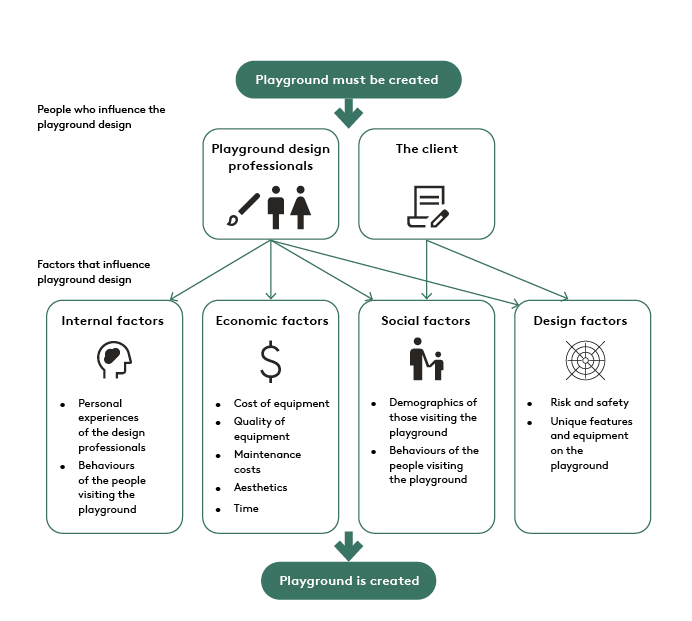
Playground design decisions are shaped by six key factors. First and foremost, the playground owner (often the person or company responsible for the playground) has a major influence, as they hold legal responsibility and control financial decisions.
The personal experiences of design professionals also play an important role. Positive experiences – either from their own childhood or from observing their children – are often reflected in designs, while negative experiences are typically avoided. However, this approach is inherently subjective.
Designs are often tailored to specific age groups, such as younger children or teenagers, but these decisions are rarely supported by empirical evidence. Similarly, risk and safety are central considerations, with choices often influenced by personal openness to different elements of risk.
Financial constraints are another key factor, including not only initial costs but also long-term maintenance of equipment.
Finally, children’s own perspectives are rarely included. There is limited involvement of children and little use of research evidence to inform design decisions related to their needs, preferences, and physical activity.
In addition, the aesthetic quality of playgrounds and their surroundings is prioritized due to its impact on visitation frequency and use.
Recommendations
Playground design is a complex process shaped by multiple, interconnected factors.
- Strong collaboration and alignment between stakeholders and design professionals are key to creating successful playgrounds. In particular, open-minded clients and sufficient budgets allow for more diverse play equipment and designs that can better support children’s play and physical activity in a variety of ways.
- However, these conditions are not always present. In such cases, priority should be given to involving the end-users of the playground such as children, their families, and the local community. Their input can help ensure that playgrounds reflect real needs and are more likely to be used.
- Greater use of research evidence in design decisions is highly recommended. Evidence-informed approaches can support the development of playgrounds that more effectively promote physical activity, play, and overall well-being.
This brief is based on
Stringer, A., Eyre, E., Crotti, M., & Duncan, M. (2026). Exploring factors that impact playground design decisions and the effect on children’s physical activity and health: a qualitative case study of stakeholder experiences in Rugby, UK. Planning Practice & Research, 1–22.
https://doi.org/10.1080/02697459.2026.2640477
How playground design decisions are made
3,2 MB